
All GenX Dating Is Grief
Compatibility isn't chemistry. It's whether your griefs can coexist

Listen to the podcast:

It’s Thanksgiving Eve and we’re having a drink — okay, maybe two drinks — when I tell Sunny Hong about Basil*.
Not everything, but just enough to give the shape of it. That he’s kind. That he feels in earnest, despite circumstances. That there’s a steadiness with him I hadn’t expected, and haven’t experienced in ages.
Sunny tilts her head and gives me her look. “So, how long has it been?”
She doesn’t say don’t do this. She doesn’t have to. Math sits there between us, tangible and unarguable, and she knows I can count it as clearly as she can. It isn’t fear or projection or even protectiveness. It’s just a clean read of the situation.
Three months.
His wife died just three months ago. After an 18-year marriage.
The data points are devastating. The lived reality behind them is worse — more catastrophic than anything I’ve been through. My empathetic heart aches for him. But my previously wounded heart is skittish at best. The risks of him are real.
I sip my perfectly crafted old-fashioned and let the doubts come out loud. Would I be just a tool in his grief toolbox? Am I foolish to think that I could be more — that we could grow to be more, together — with the healing passing of time?
When does too recent become too late to still deserve happiness?
Sunny interrupts my internal questions with a blunt declarative: “Dana, you can’t date a man so soon after his wife died. He’s still grieving.”
She’s got a point, but it’s not quite right. Because the 14 years of dating since my marriage ended have taught me a hard-won lesson: by this stage in life, we’re all grieving.
Sometimes it’s acute, sometimes it’s chronic. But if we want to pursue a relationship in late-midlife, there’s a truth we need to face head-on with our hearts open.
All GenX dating is grief.
I don’t always mean grief from death, though sometimes I do.
If you’re 50-something and dating, the pool is full of people carrying grief. A marriage that ended. A partner who died. A romantic betrayal. A version of yourself you thought you’d be by now that quietly stopped being possible somewhere along the way. Years of wanting a particular life and watching the window for it slowly close.
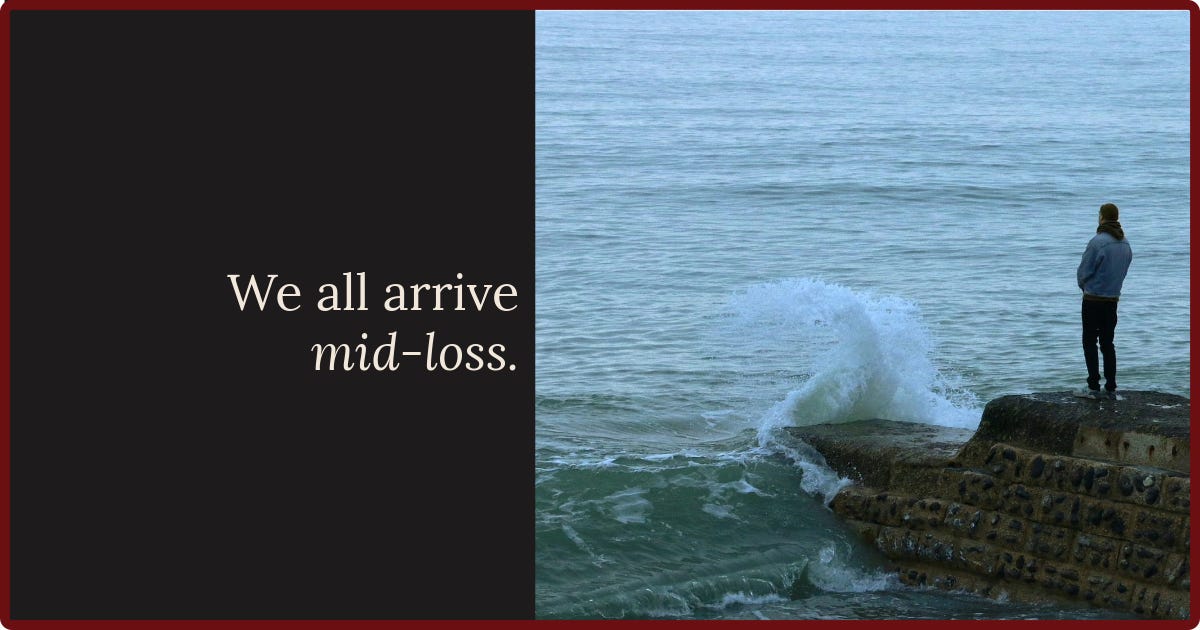
We arrive at each other already mid-loss. Sure, we’re scanning our prospects for the usual things: chemistry, smarts, values, whether we share a sense of humor and taste in music. But through it all — thrumming alongside the apps and first dates and the initial performances of being emotionally and romantically available — is figuring out whether the grief I’m carrying and you’re carrying can coexist.
What looks like attraction at this age is often two people reaching toward each other from inside their respective rubble.
Widowers deserve their own reckoning.
At 55 years old, you might think I was just entering my widower era. But you’d be wrong.
The duality of dating a widower is complicated. In a dating culture full of men who avoid, who keep one foot out the door, who treat relationships like extended auditions — a man who loved someone until she died can look like proof. Proof that he’s capable of depth. Proof that he understands what love actually costs. Proof that when things get hard, he doesn’t leave.
The widower arrives pre-vetted by the hardest possible test of commitment. Only till death did he part.
So women like me, looking for a man with real capacity for love, read his grief two ways at once: warning and credential. Sure, he’s grieving. He’s also passed a test most men never even take.
He’s a paradox. His grief is the warning and the evidence at the same time. Because the same devotion that makes him appealing is what makes him unavailable. The depth of love that kept him there is the depth of loss that keeps him stuck.
You can’t have one without the other.
You’re attracted to the very thing that can undo it all — and you won’t know it until you’re already in.
I know this because I’ve lived it, repeatedly, across decades of dating.
Chad was first, a young widower, in his late twenties when his wife died in a hiking accident. His fresh grief plucked me from my online dating profile. He said he liked my pixie haircut and taste in music. In hindsight, I suspect he liked my distance best — I was two states away. I was also eager for connection after a hard breakup. He called and emailed with abandon — it was the early 2000s, after all —and then flew up to visit. I thought our romantic whirlwind of a weekend signaled an enduring interest. In reality, the rush helped him grapple with his grief.
I never heard from him again.
I was in my early thirties and had little language for what had just happened. I thought it was a sad story about a specific man. I didn’t understand yet that I’d just been handed a map I’d be reading for twenty-five years.
The clearest version came years later, in my forties. His wife had died of ovarian cancer a couple years earlier, leaving him with a toddler and a life in mid-flight, anchored in the home they’d built together. I thought I loved them both enough to build a home and family with them. So I leapt toward them, rearranging my life around theirs in ways that felt both intentional and inevitable. He promised he’d catch me.
In the end, he didn’t. He couldn’t.
Grief is a terrible timekeeper, nonlinear and unpredictable. It doesn’t respect milestones or anniversaries or sacrifices or the logic of it’s been long enough. Years passed, and still, his life remained anchored to what had been: their home, their routines, the way he thought about the future — all of it stagnated. So long as I could squeeze into that structure, things worked. But he never tried to build something that was ours.
I bore the brunt of his immobility because I was first. Whoever came after me likely had it easier.
But grief can never provide a clean transition from understandable to resolved. At no point can you look at someone and know, with any certainty, that they’re ready. Ready is a fallacy, a word we use because we want to impose a framework for heartache risk mitigation.
Ready doesn’t exist.
When it comes to grief, you always make the romantic call with incomplete information.
And it isn’t just widowers.
I’ve dated men who’d technically left their long-term marriages but hadn’t actually left yet — they were still entangled, still emotionally oriented toward a life they were in the process of dismantling.
I’ve dated men whose intensity at the beginning felt like desire and turned out to be something closer to frenetic momentum — a need to land somewhere new before they had to fully feel what they’d just lost. Commitbombing isn’t always manipulation. Sometimes it’s grief moving fast so it doesn’t have to sit still and be felt.
I’ve met men who initially seemed emotionally and romantically available — but had been shaped by years of caregiving or quiet depletion in ways that weren’t visible at first. They don’t look like grieving men. They look like unavailable, avoidant ones. But they’re grieving, too. And it’s unprocessed grief, stagnant and fetid once you catch a glimpse of it. So they keep it well hidden.
I’ve dated men who were overburdened with parenting, men whose co-parents were absent — through illness, avoidance, or death. These men did their best. But they all carried the grief of parenting without an actual partner. Many claimed they were drawn to me in part because I loved being a mom. But none actually wanted me to be a significant part of their kids’ lives. Some never let me meet their kids. Some introduced me, but barely. One broke things off with me immediately after our first sexual encounter with a panicked, “My children are grown and I don’t want to be a stepdad!” His kids had addiction issues and lived with their mom full-time. I’d never asked.
It stung. But I can see now: it all came from grief.
Living grief. It doesn’t get named as grief, which makes it harder, because we lack vocabulary to discuss it.
At least the widower’s loss has a word.
And then there’s the kind of grief that doesn’t get named at all.
No funeral. No paperwork. No moment where the world acknowledges that something ended. Just the accumulation of years without a partner. The almosts. The repeated heartbreaks that didn’t break me, but cost me. The slow realization that the partnership you thought you’d have by now didn’t materialize.
That’s my grief.
It doesn’t announce itself. It doesn’t reorganize the room. It just sits underneath things, shaping how I move through relationships, how I read signals, how quickly I can feel the edge of the rug before I’ve even fully stepped onto it.
Because the rug’s been pulled enough times that it’s threadbare. I check the edge with my toe before I step. That’s not paranoia. That’s pattern recognition. My nervous system learned this the hard way, and it knows what’s underneath: hardwood, solid in its way, the place I’ve actually been standing all these years.
Grief is the wound. Baggage is what forms around it. The rug? That’s mine.
And the floor, when the rug gives way, is colder than people understand. Because while the men I’ve described are processing acute, recognizable losses — losses with names, dates, Facebook posts acknowledging milestones and communal grief — I’ve quietly endured fourteen years of an unacknowledged loss.
Chronic grief. No one brings me casseroles. I’ve learned to make my own, to build the life I’ve wanted anyway. I’ve weathered professional and financial instability solo, and endured. Triumphed, even. I’m a more resilient and self-assured person for it. And also, I’m tired — and every almost-but-not-quite man who doesn’t work out feels like a kick to that structure I’ve already had to rebuild more than once.
And it’s all borne in stoic silence.
Because when chronic grief meets acute grief in a relationship, the acute grief wins. Every time. It’s louder, more legible, has a shape the other person can point to. Chronic grief has no shape. It’s less thunderstorm than steady drizzle — the kind you’ve been sheltering from so long that others stop noticing, and you’ve forgotten what it costs you to stay dry.
So I walk into every new beginning already carrying fourteen years of unwitnessed loss. And somehow I’m still the one making room for grief.
Scarcity also enters the grief conversation, especially for widowers.
An eligible, relationship-oriented man in his fifties is sought after in a way that a woman of the same age, with the same qualities, simply isn’t. The pool is asymmetric. So a widower arrives with proof of his capacity for long-term love, and women will absorb the grief, wait through it, make room for it — because the alternative is a shrinking pool full of men with no intent to stay for anything.
A woman in the same situation doesn’t get that patience. Her loss reads as baggage where his reads as capacity.
The market rewards his loss and discounts hers. That’s not cynicism. That’s the landscape.
My mother’s partner was married for fifty years. When his wife died, he pursued my mother within a month. Nobody blinked. His family was supportive. That was the boomer protocol — re-partner fast, because heteronormative coupling was so woven into the texture of life that the absence of a partner registered as the emergency, not the depth of the recent loss. There was no question of how long to wait, especially as they’re both in their late seventies. The answer was as soon as possible. And they’re happy.
GenX is the first generation without that protocol. Half by feminism, half by lived experience, we were taught that being alone is survivable, even valid or preferable following loss. This means we lack a social norm for how long is long enough. Basil doesn’t know. I don’t know. Sunny doesn’t know either, even as she’s asking the question. Three months seems too soon. How long is too long?
We’re improvising the timeline of grief in real time, on apps, with people whose losses we can’t fully see, with no rules telling us how long is reasonable. The norm isn’t being defied.
The norm doesn’t exist yet.
So now I find myself here.
Interested. Attracted. A bit reticent. But present.
I’m starting something that feels real, with someone whose grief isn’t abstract or historical but present in a way that’s both understandable and, at times, unsettling — not because he’s doing anything wrong, but because I know how vulnerable and unpredictable grief can be.
He’s pretty wonderful — steady in a way I can feel, honest about where he is, not asking me to be the only place his grief lands. His face lights up when he sees me. He has incredible taste in music. And his warm hands tingle on mine when they touch.
And still. At my lowest moments. I eyeball the edge of the rug and I think: any time now. He could say I’m not ready, I can’t do this. And that wouldn’t be a betrayal or failure. It would just be the truth.
And if I mourned the loss, my friends would shake their heads. What did you expect? they’d ask. You chose to date a widower.
They’d be right. But also, they’d be wrong. Because grief is a terrible timekeeper, and we’re all carrying it. Not just the new widowers, but also the chronically unpartnered like me. His may be louder, but mine persists; it whispers, you should leave before you get knocked down again. It’s an immense, unacknowledged act of courage not to give in to my grief.
I think Basil sees this.
And that makes it easier to stay and try.
Sitting beside his widower’s grief, I discover a new one of my own. It’s a strange, vertiginous wish: that his wife were still alive, even if it meant Basil and I never met.
It’s not a gesture or sacrifice, but rather a sense of clarity. If the best version of his life is one where she didn’t die, where they’re still together, where none of this ever had to happen — then of course I’d choose that for him.
That’s the strange thing about caring for someone in deep grief. The closer you get, the more clearly you see the world they were already living in before you arrived, and how complete it was.
I’m not jealous of her. I grieve her.
On his behalf, and a little on my own — for the sort of life he had, the kind of life I haven’t known for so long, and for the version of him that existed inside it, whole.
Midlife connection requires a shared vocabulary of loss.
What I’m learning now, as I seek partnership this far down my life’s path, is that joy and sorrow aren’t opposites. They aren’t even taking turns. They live in the same hour, in the same person, sometimes in the same breath. That’s not a betrayal. It’s integration. It’s what midlife actually feels like.
So the question at this age isn’t whether grief is in the room. Grief is the room. The question is whether your joy can sit with their sorrow without one having to swallow the other.
That’s compatibility now. It sits alongside values, lifestyle, record collections, and whether your pets get along. As you answer those questions, watch for whether your griefs coexist.
If they can’t, the rest of your list won’t save you.
What are you thinking, getting involved with someone in active grief?
Everyone is in active grief.
There’s no version of dating at this age that doesn’t involve it. The choice has never been between someone who’s grieving and someone who isn’t. It’s always been between different griefs, different timelines, different levels of legibility — and the unspoken negotiation, in every new beginning, of whose loss gets to be loudest in the room.
We’re all trying to figure out if our particular flavors of grief are compatible. Whether there’s room for both. Whether the thing we’re building together is strong enough to hold what we’re each carrying.
Grief is just proof that love was real.
Which means if you’re still looking — if you’re still showing up and stepping onto rugs that might give way — you’re already living inside the very thing that makes love possible.
*All names changed for privacy.
Thanks for reading.
I’m Dana DuBois, an essayist and GenX word nerd living in the Pacific Northwest—and founder of I Write Out Loud and co-host of The Daily Whatever Show. Through memoir writing, I explore the larger cultural forces shaping relationships, feminism, parenting, media, modern dating, and life in mid-flight. Em-dashes, Oxford commas, and well-placed semi-colons make my heart happy.
If this story resonated with you, please consider supporting my work with a paid subscription.
