
The Father I Got vs. The Father Dementia Gave Me
What happens when the man who scared you becomes the man who needs you?

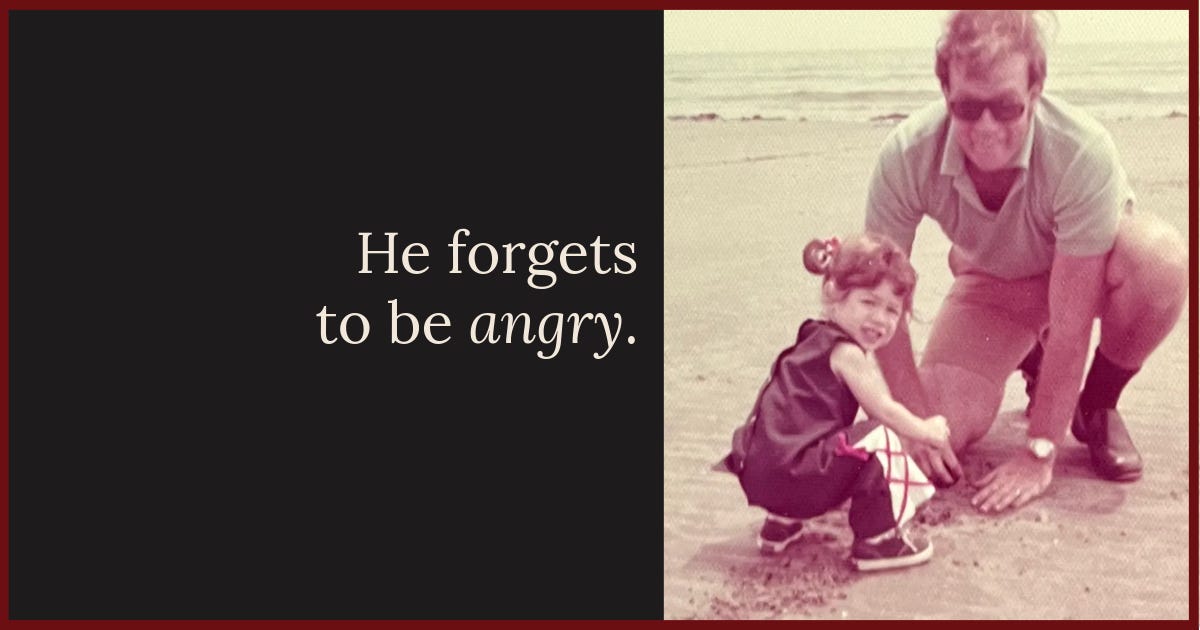
Father's Day is complicated when your father is hard to love.
The cards in the drugstore aisle assume a simplicity I never had: the warm dad, the wise dad, the dad you'd want to grab a drink with. Mine was none of those things. But then dementia moved in, and something shifted.
Not into the relationship I wished we'd had, but into something else entirely—something I'll feel this weekend, when I call to wish him a happy Father's Day, even though he won't remember a word.
“I don’t think I’ll ever live to see 70,” my dad sighed, turning toward me as he paused at the traffic light.
My dad became a father in his mid-20s, right about the age I was when we had this conversation. My brain was barely on the cusp of adulthood. Too young to know how to respond. Too young to be handed that kind of emotional weight. The light turned green and he turned his focus back to the road, and away from me, thankfully.
I had no idea what to say.
Because honestly? I didn’t disagree with him. By his early fifties, he’d already had five — yes, five — angioplasties. His mother, my namesake, died of a heart attack at 50. And he had the whole cardiac-risk vibe going for him: overweight, barrel-chested, subsisting on a terrible diet, and fueled by Type-A rage.
It didn’t bode well for longevity.
But looking back now, decades later, I’m struck by the lack of boundaries in that moment. Why tell your twenty-something daughter you’re pretty sure you won’t make it? I didn’t have the emotional capacity then.
He didn’t have the emotional tools, ever.
I still don’t have an answer to those questions. But I believe he wasn’t so much hoping for a wise reply from me as he was reckoning with himself, with an audience. Perhaps he feared dying young.
Or maybe he feared what would happen if he didn’t.
Spoiler: he didn’t die young.
I’m now older than he was when we had that car conversation.
But he’s still here — more or less.
I can’t say that my dad is happy now. But I’m not sure he ever aimed for happiness. He was more invested in verbally dominating anyone who inconvenienced him and watching sports he could bet on.
We’ve never been close. His anger was a consistent presence in my childhood, and emotional availability wasn’t part of the repertoire. Losing him early would not have been devastating. Perhaps that’s why I froze in the car when he mentioned his likely early demise.
But he did make it to 70. Against his own odds.
For his 70th, he wanted a family trip — me, my brother, our kids. So we met in San Diego at a resort he and his wife loved. I braced myself but showed up. He’d earned that much by simply making it to 70.
My girls were six and four. He was elated to see them; they didn’t know what to make of him. It took only minutes for him to drop one of his legendary inappropriate comments, and it was a doozy. “When you’re older, will you share your boyfriends with your sister?” he asked my eldest.
The kids stared, stunned. I intervened, gently but firmly. And I spent the entire trip ensuring he was never alone with either of them.
Later, on his birthday dinner outing, he was unable to parallel park his giant rental car — something he’d never done much living in Florida. His wife shrieked from the backseat, “You’re doing it wrong!” He yelled back, telling her to shut up. Annika covered her ears and cowered, horrified.
My kids are Pacific Northwest children — raised on passive-aggressive conflict, not screaming.
“I’ll do it,” I told him gently, referencing my Seattle-parallel-parking credentials. He didn’t want to give up the wheel — driving was always a man’s job — but we had a reservation to make, and he’s nothing if not food motivated.
Once everyone was out of the car and on the curb, I backed it in with ease.
“This is how they are,” I told the girls later. “Not happy, but not unhappy. Just… fine. Thankfully they live far away. Can we get through this for a couple more days?”
They nodded, absorbing — for the first time — how other childhoods existed.
And this is how he made it to 70: fraying a bit at the edges, but still essentially himself.
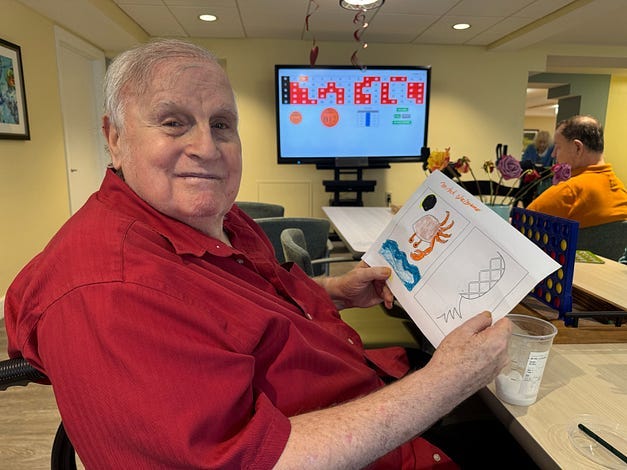
My dad lives in a memory care unit now, since his wife died a few years ago. Moving him there in the days following her funeral was agonizing. But now? It’s his normal. He’s the star bingo player. He answers all the “On This Day in History” questions during morning trivia. He plays balloon volleyball.
He beams during pet therapy visits.
He likes the food in the cafeteria. He’s somehow managed to gain quite a bit of weight, in spite of the portion restrictions. We suspect he’s convinced the staff to bring seconds… or thirds.
Sometimes he colors. On my last visit, he proudly held up a page with a crab and a wave. “It’s good, isn’t it?”
“It sure is, Dad.”
It’s strange to see him like this, the tyrant of my youth now a docile old man with crayons. I can see he’s doing okay.
Not thriving, but fine.
Not happy, but content enough.
But I can also see the man he was. And that man would rather have died than lived like this.
I called my dad for his 81st birthday.
He can’t use his iPhone independently, so I have to call the nurses’ desk for someone to hand him the phone.
“I miss my mom and dad so much,” he told me.
This was new. He’d never talked like this in his fully cognitive life, nor in the early years of dementia.
“Tell me about that,” I said.
“Well, the people here, their parents come to visit them. And I’m here all alone.”
He knows who I am. He knows I’m his daughter. But he rounds everything — need, loneliness, longing — down to the simplest form of love he can name: parents.
He wants his mother. He wants his daughter. He wants someone who feels like home.
I don’t correct him. That feels cruel now.
“Well, one of these days soon I will get down there again.”
“Good,” he replied. “Because I’m 81 years old now. I don’t know how much longer I’ll be here.”
I think, I’ve heard you say that before.
And here you still are.
As hard as dementia is, it’s been a strange mercy.
Dementia stripped away my dad’s anger. It pulled back his defensiveness. It revealed the vulnerable little boy who never really learned how to father anyone, including himself.
It doesn’t justify what he was like when I was growing up.
But it does contextualize it.
Dementia didn’t erase the father he had been, but it stripped away enough of the armor that I could finally see the frightened child inside him. In losing pieces of himself, he’s gained something gentler. And I’ve gained access to a part of him that never existed for me before.
Does he feel the healing too? Does he sense how much lighter his relationships are without rage running the show?
I hope so.
If not dawning peace, then what is the point of his limited, liminal final stage of life?
I have to think it’s connection.
So this weekend I’ll call my dad to wish him a happy Father’s Day.
Maybe he’ll tell me how much he misses his parents, or that he doesn’t know how much longer he’ll be here. He won’t remember he’s already told me.
I hope he’s finding some peace in his here and now, in his own dementia-fueled reckoning with the life he ended up living, instead of the one he imagined.
He thought he’d die young. Instead, he lived long enough to become someone I can finally meet with compassion.
And here he still is.
Thanks for reading.
I’m Dana DuBois, an essayist and GenX word nerd living in the Pacific Northwest—and founder of I Write Out Loud and co-host of The Daily Whatever Show. Through memoir writing, I explore the larger cultural forces shaping relationships, feminism, parenting, media, modern dating, and life in mid-flight. Em-dashes, Oxford commas, and well-placed semi-colons make my heart happy.
If this story resonated with you, please consider supporting my work with a paid subscription.
