
An Ambivalent Jew Returns to Germany for Taylor Swift
I feel echoes of what once happened here. My daughters felt nothing, till I showed them — and they showed me.

Listen to the podcast:

A few years ago, I spat into an Ancestry.com tube and eagerly awaited the results.
My whole life, I’ve only known I’m an Ashkenazic Jew — or as I’ve described it, an Eastern European mutt. My direct family line immigrated through Ellis Island ahead of the first World War; my grandparents were born in the U.S. right before the Great Depression.
Any relatives who stayed presumably died in the Holocaust.
I’m indifferent to all religions, including my own. I don’t identify as Jewish, religiously or culturally, even as I went to Hebrew school and had a Bat Mitzvah. I also have green eyes and freckles, and loads of natural redheads in my family. Years ago, a dermatologist asked me, “you’re Celtic, right?”
I laughed. “Not unless there are Celtic Jews.”
It got me curious though. Maybe I was something other than just Jewish? Nearly 6,000 years of history, surely someone in my bloodline had an illicit affair, or… something? Or at a minimum, perhaps I could find my European roots, to learn which countries were in my bloodline, as I had no living relations overseas left to ask.
But no. My results came back as 96% Eastern European Jew. No countries identified — I guess the Jewish diaspora transcends borders? — and the remaining 4% hinted I might be a little Scottish, but inconclusive.
Identity is so interesting. I don’t choose to identify as Jewish or raise my children as Jewish. Yet Judaism is baked into my very cells, a hard-coded part of what makes me, me. I may not practice, but I also can’t deny it. I was hoping a genetic test could tie me to a specific country or two in Europe, but no. Just Jewish, still, in spite of my choices otherwise.
It seems I can’t choose not to be Chosen.
I envy my friends who return to the old country and find long-lost relations, a tie to their histories. This is another wound in my family of origin story, and one I share with most other Jews: no one remains. While others find long-lost cousins and uncles, I tour Holocaust museums, former Jewish quarters, and cemeteries.
I have no people here.
All I have are memorials.
My first Euro-adventure was in the mid-90s with my childhood best friend, Denise, also a non-practicing Jew. We railed all over the continent with a carefree ease, but when we reached Germany, we faced similar triggers.
The sounds of the German police sirens made us wince. We gave each other knowing glances, spooked at certain older train stations. And when we visited the Dachau Concentration Camp memorial together, we felt similarly shaken, a shared kinship in really feeling the horrors that had happened right where we stood. With different timing and circumstances, we knew this fate could have been ours, or we might never have existed.
We’d been raised on Holocaust films. “Never forget,” our Hebrew school instilled in us. And we couldn’t. We’d meet kind older German people and wonder, what did you do during the war? Our very cells could feel this birthright in Germany, a disquieting shared sense of a danger passed, but adrenaline lingering.
Now I’m back in Germany — Munich, to be specific — with my two teen daughters. We’re here for four days to explore the city before we go to see Taylor Swift perform at the Olympiastadion. It’s a dream come true after four failed attempts at procuring U.S. tickets, and also their first time overseas.
We’re jetlagged, a bit dazed, and eager to explore.
We’re also very, very hot.
Munich is blazing this late July, and public spaces lack the modern HVAC comforts of home. The trains in particular are stifling; we are coated in sweat, taking in the stench of humanity crowding in on us. My children are irritable, as am I.
But I’m not just sweltering.
Underneath the perspiration I feel unsettled, recalling stories of a not-so-long-ago time drilled into me as a child, distant but omnipresent. I’d nearly forgotten this feeling: the low-key sense of unease, a shadow of distrust, a flinch of a siren. And this trip, when I look to my travel companions to commiserate, they don’t get it. I didn’t raise them to understand this.
I’m resolved to teach them, at least a bit, while we’re here.
I can imagine the stifling crowds of WWII-era families on trains, over-packed into sub-human boxcars with no idea of where they were heading or if they’d survive the journey. I feel my pulse quicken in rhythm with the train’s rattle and breathe the stagnant air in through my nose, and out through my pursed lips as I look at my children sitting across from me on the tram. They’re wilting, but they will be fine.
I feel the ghosts of parents on past trains who lacked this assurance.
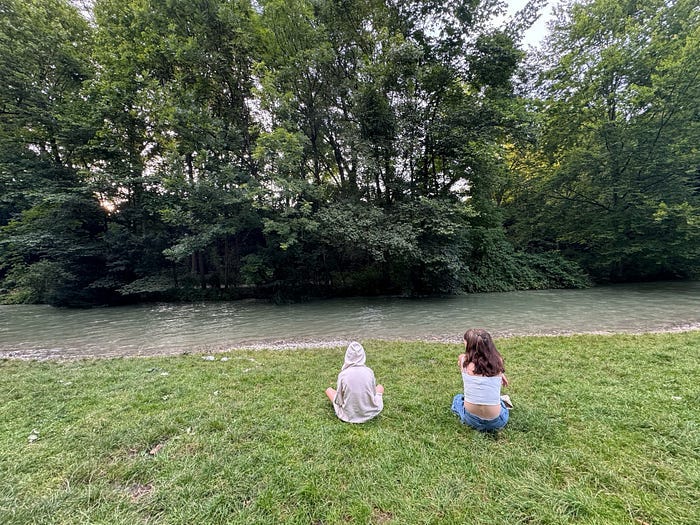
We arrive at the English Garden, an hour or so before sunset on our first full day in Munich. The blazing heat has abated a bit, and we enter a corner of the massive public park near a river. We’re jet-lagged and weary, and my children take a moment of respite by the waters’ edge.
“I was just remembering last fall when it was gray and rainy and we watched Twilight,” says my youngest, cheeks flushed. “I’m so in the mood for a night like that.”
Me too, kid…
We take a few steps onward from the river, unsure where to go and fading fast, when we see a man pedaling a Rickshaw for rent. We hop in and race forth, taking in the majestic beauty of this park while he narrates for us in mostly perfect, heavily accented English.
The breeze from the speed of his pedaling cools us off as his friendly tour charms us. The English Garden is one of the nicest public parks I’ve ever seen, more massive than even Central Park, with four square kilometers worth of greenery, winding paths, bridges, and beer gardens.
I see how the fine folks of Munich thrive here: running, drinking, socializing, dog-walking, cycling, and even surfing. Here I smile at my children and feel safe, far safer than I’d feel in any American park at dusk.
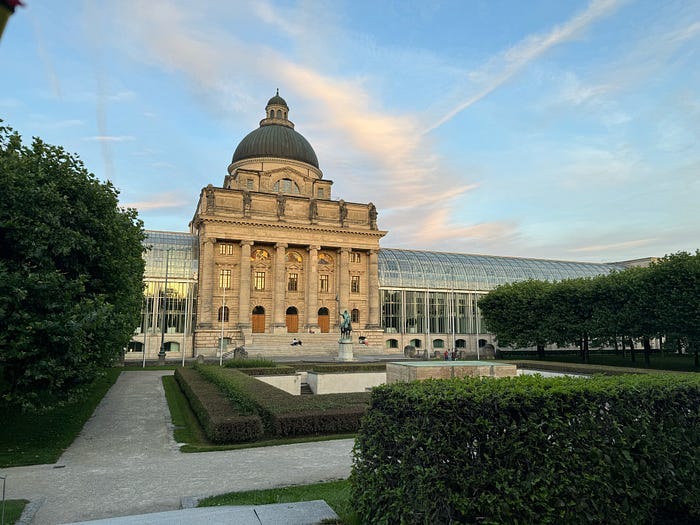
We detour from the park and head toward the historic Marienplatz square, and pass the Bayerische Staatskanzlei — the Bavarian state government building — with its original historical architecture in the middle with modern glass structures on either side. “The sides were blown off in the war,” he says. It’s a neutral statement but I can hear the lament in his voice for what was lost.
I’ve heard hints of this sentiment from Germans before, including my ex-boyfriend Franc, when Denise and I visited him during our trip to Germany in the 90s. “How do they teach the Holocaust in German schools?” I’d asked him when we were dating.
“Oh, that we were wrong, but there were other sides,” he answered.
I didn’t quite understand that answer until we visited the Kölner Dom together, and across the street in a tourist shop we saw a WWII-era postcard of the plaza, with the Dom partially blasted and an American tank in the foreground. Franc pointed at it and said to Denise and me, “Can you see what happened here??”
He was in earnest, aggrieved at how an American tank had partially destroyed the beautiful landmark we’d just climbed.
At 25 years old, I lacked the audacity to respond to him directly. But afterwards Denise and I shared our disbelief in typical GenX fashion, with wry humor.
“Oh, did you lose a building?? We lost our entire family trees!” I shouted at him, via her.
“Of course the U.S. bombed you, you were out of control!!” Denise chimed in, both of us laughing at how absurd he was to direct his indignation at two Jewish women, as we faced down his country and the impact of a near obliteration of our people.
We’d both been raised to fear Germans and Germany. Our grandparents lived through the Holocaust and our parents were raised in its wake. I was a generation removed, and I’d loved Franc. I could never fear him. But still, I knew in my bones I couldn’t follow him to Germany.
His reaction to that postcard perfectly captured why.
Our hotel in Munich is modest but has air conditioning, a delicious breakfast, and a community of Swifties from all over the world.
We meet three young women from “north of the Arctic circle,” a mother and daughter from London here for their third Eras Tour show, and many, many Germans. By Friday, the hotel adds a cardboard life-size Taylor to the lobby in advance of the Saturday and Sunday shows.
The excitement is palpable.
Our tickets are for Sunday, so on Saturday we head north toward Dachau, to visit the concentration camp memorial. On our way to the bus, we stop at Rossman to pick up some essentials: European cookies, tampons, hair oil, and for the show, earplugs.
“It’s like a bougier Bartell Drugs,” jokes my eldest, trying to locate just the right product to battle the unfamiliar water wreaking havoc on her hair. We all wander, delighting in the unfamiliar products. “Mom, they have vibrators!” my eldest calls with glee. I hope no one who can translate is in earshot.
I scan the aisles: dental care, foot care, eye care. But no ear care. I ask the older ladies behind the counter if they speak English. They don’t. So I use Google translate and hold up my iPhone: “ohrstöpsel, bitte.” They nod in understanding and wave me back in the general direction of the personal care aisles.
I search again, to no avail — no ohrstöpsel in sight.
Sensing our confusion, a young German woman offers to help. Her name is Mira, and she’s got a Taylor Swift tote on her arm. As we scan through rows of dental floss and deodorant she explains how she had to buy VIP tickets for the show because they were the only ones left. “My husband questioned if I needed to pay 300 euros for this show. I told him absolutely yes.”
As someone who’d flown nearly 6,000 miles for the show, I totally understand, and tell her she’s gotten a bargain. “Vancouver and Miami tickets cost about $3,000 now,” I say, and she looks astonished.
The eldest interrupts our conversation, triumphant, with two pairs of earplugs in hand. “They were next to the vibrators!” she exclaims.
We all laugh, and we thank Mira for her help and wish each other a great show, buy our ohrstöpsel, and head out to find the 710 bus to Dachau. Google Maps sends us in a circle as we look around, confused. Two German men notice and ask, in English, “Do you need help?”
They study the map and explain where we need to go. One even walks across the block with us and points to the tunnel to the next “platz” over. We thank him and board our bus.
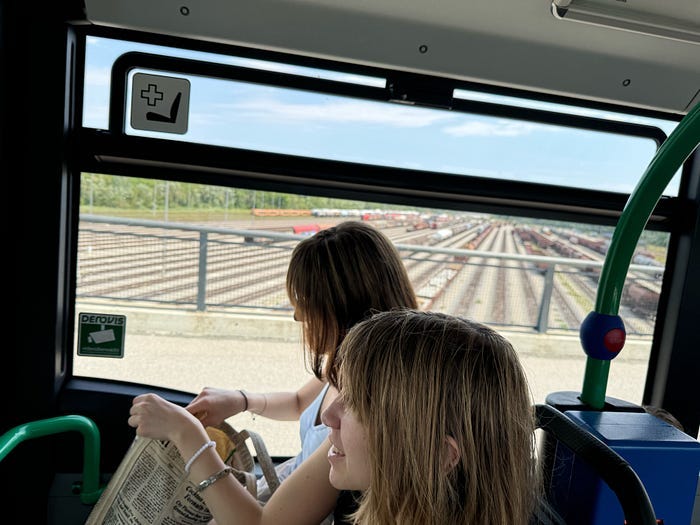
As we ride, I marvel at how helpful German strangers have been to us. Then I’m bumped from my reverie. I notice us passing over many lanes of train tracks and rail cars. The visual of my kids in the foreground and the once ominous rail cars behind them gives me pause.
They take no notice.
I’d like to say our tour of Dachau illuminated my children to the horrors of the Holocaust and helped tie them back to their Jewish heritage. In reality, we arrived after two oppressively hot bus rides, my two teens already halfway checked out and cranky.
Dachau is stark, with a long walk across white rocks to get from the entrance to the crematorium at the other end. The sun reflecting off the bleached ground burns our eyes, bright and penetrating as we trudge the length of the camp, so that the shade offered by the concrete crematorium feels like an ironic respite.
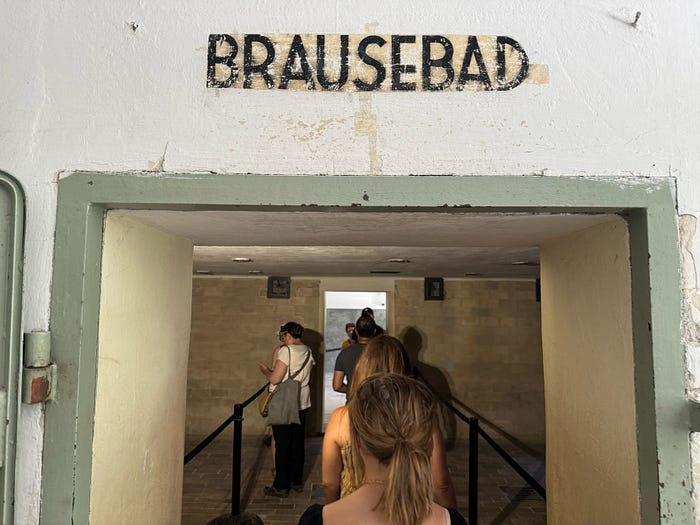
The crematorium was a simple, short passage from entry to death. A waiting room, where the victims were informed of the supposed “shower” to come. Then the disrobing room, where they dropped their clothes. Then the showers. I paced that room from end to end, a bit claustrophobic. It was only 18 steps long. They packed 150 naked people in at a time, and then turned on the alleged shower, which rained gas instead of water.
Then the death chamber, where they piled up the dead for cremation.
Then finally, the crematorium.
Despite the heat, I feel every chill I felt last time. I watch my kids, walking back and forth from one room to the next. They don’t say anything; they just observe the stark concrete spaces and read the signs.
Then they ask if we can leave, before seeing the rest of the memorial. Part of me wants to insist we visit the barracks, the museum, the movie. But most of me realizes: it’s too hot, and dragging my kids through a miserable right-now is in no way going to teach them about this tragic past.
They’d already seen the most awful part.
And so we leave.
Worn out from the heat and the long ride, we ask the hotel clerk for a local recommendation for dinner. Our simple meal at Moosach Bürgers is delicious, and our server, delightful. We’re happy, sharing stories and leisurely dining outside as we watch the sky light up from what I thought was heat lightning.
Then we hear the clap of thunder.
And then the rain starts.
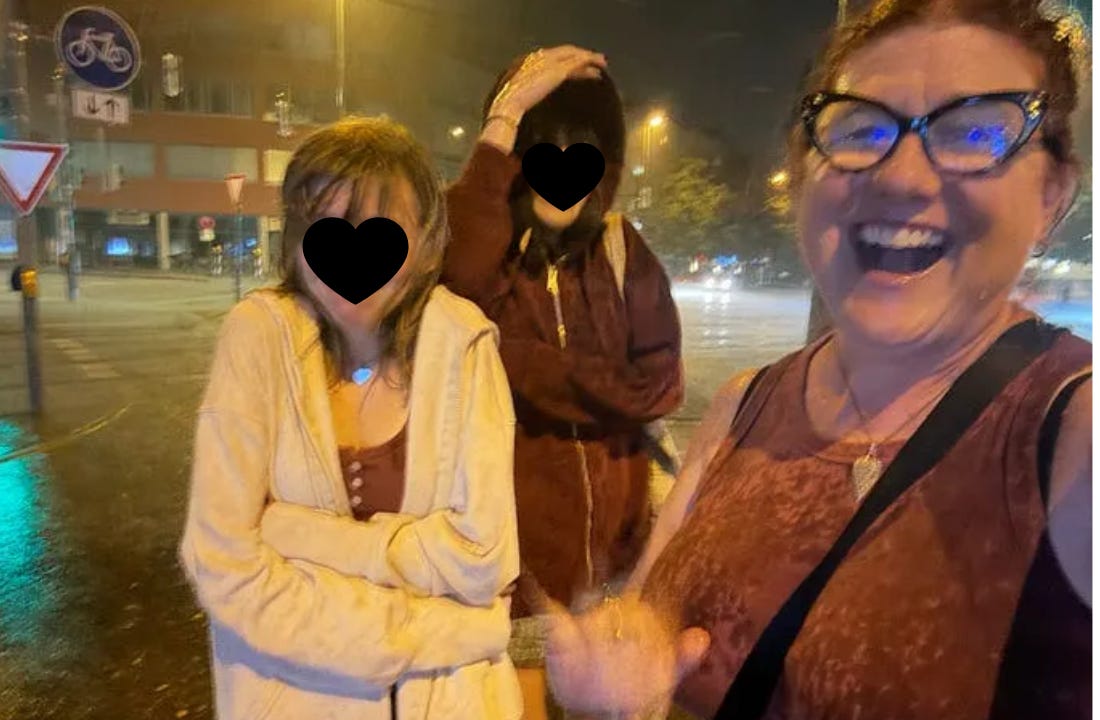
It’s not in the forecast, but a storm is real and it’s here. We sprint the two blocks home to our hotel, laughing and relishing the downpour. “You got your wish!” I yell to my youngest over the deluge.
Back at our hotel, my eldest heads up to shower, and my youngest and I stay in the lobby to greet the Swifties as they return from the Saturday night show. With eyes alight they swap friendship bracelets and share stories, a spirit of shared joy elevating us all.
We’re so happy not to be hot any longer and so excited for the show the next night, we don’t mind that we’re soaked
I’m worried about the Taylor show.
I’m worried because we’d never been to this stadium. I’m worried about finding a spot with our general admission floor tickets. I’m worried because no outside food or water is allowed. I’m worried because I don’t know when to arrive, or how to find our way into the stadium. I’m worried because of so many unknowns.
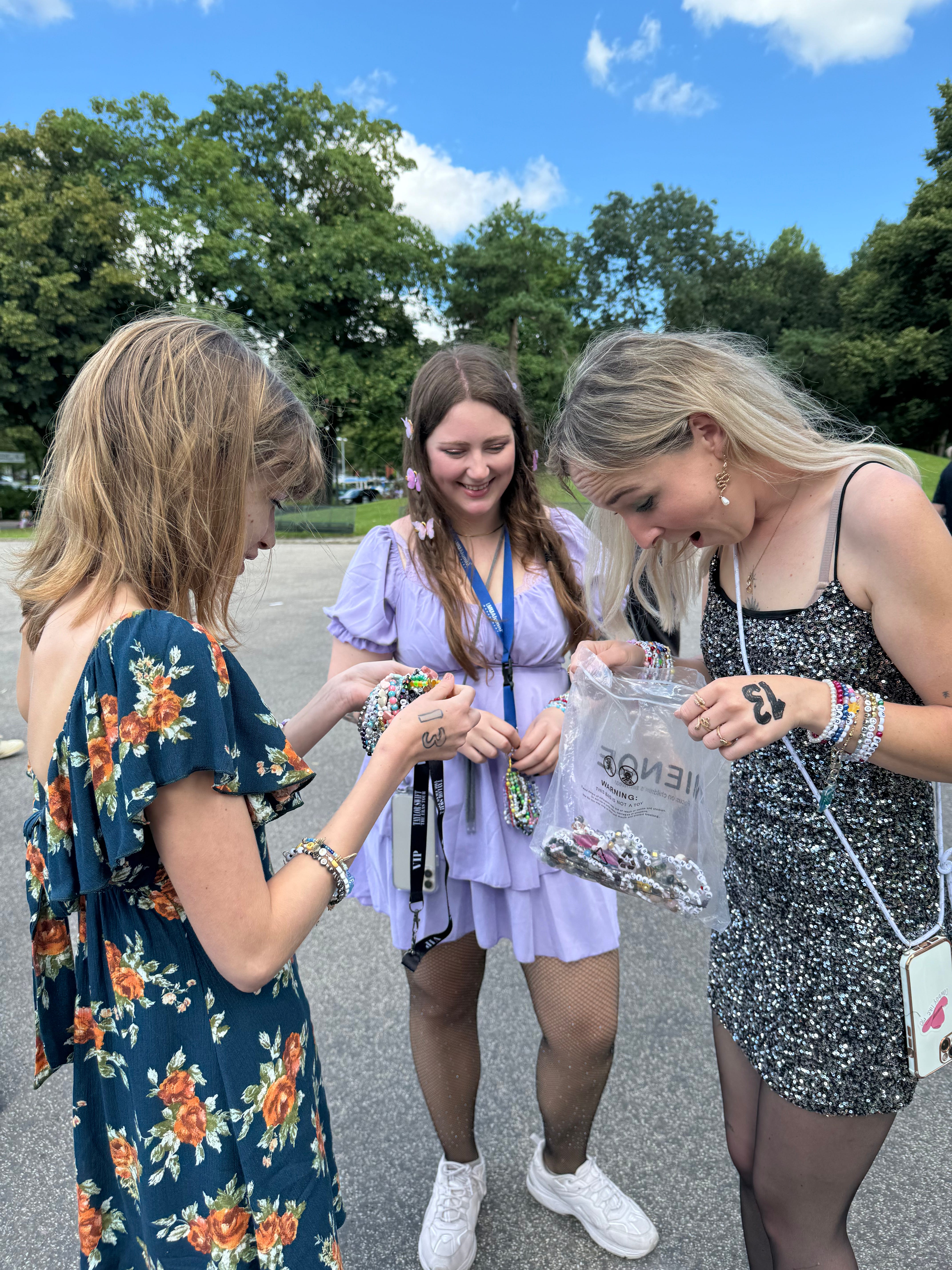
We take an Uber and eventually find the line to get into the stadium. And we wait and we wait and we wait — for four hours, we wait. We have no food or water because we were told not to bring any. Thankfully, the nice German family in front of us shares their snacks with us and keeps us company, and my youngest trades bracelets with them and many others who pass by. The wait is long and hot but fully tolerable, enjoyable even.
Then we finally enter the stadium.
I was counting on German efficiency and rule-following. But I was wrong.
I’ve been attending rock shows for 40 years, but have never seen utter chaos like what we entered. I grabbed onto my teens as if they were toddlers again as we dove into the teeming masses of humanity, all swarming in different directions and trying to figure out where they were supposed to go. German voices shouted all around me as I grasped my kids even tighter. This was way worse than the sound of German police sirens; feeling part of a mob of Germans who might separate me from my kids made me start to panic. Breathe, I told myself. This is a concert, not a concentration camp.
But still. If we got separated, they wouldn’t be able to get into the show without my digital tickets, and I doubted we had cell coverage to find one another with so many people around. My youngest hates crowds and chaos. I glanced at her ashen face and knew I had to keep it together and get us in.
We stood in several sort-of queues and fought our way to the front, only to be told to go elsewhere to get down to the field. I persisted. Finally, we somehow entered the right one, and I teared up at the sight of the stadium.
At long last, we were inside.
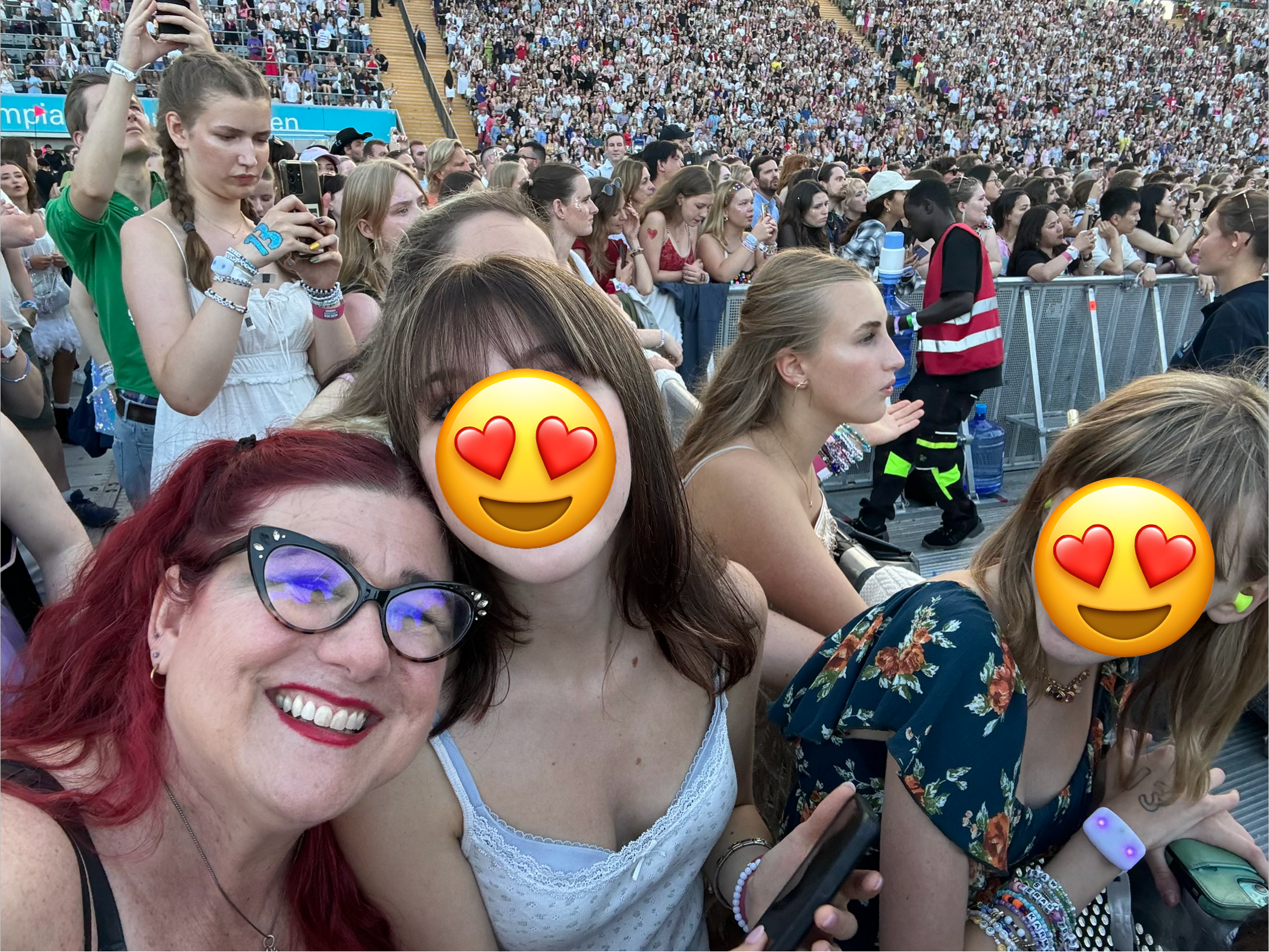
We got down to our section of the floor — front of stage two, one of four general admission sections in the front half of the arena — as opening band Paramore took the stage. We’d jockeyed our way a bit forward, and my eldest and I had decent views of the band. But my youngest couldn’t see a thing. She’s barely five feet tall and 80 pounds. She was no match for the general admission floor full of super fans.
She was nearly in tears the whole set.
Had we flown this far and spent all this money, only for her not be able to see the show? I felt distraught — not out of fear from the past, but frustration in the present.
During the break between bands, we nudged more to the center, behind the lighting tower, where a mother and her daughter sat against the front of the tower base. The daughter had her arms stacked full of friendship bracelets, as my youngest did.
“Want to trade?” she offered my youngest.
As the girls exchanged bracelets, I greeted her mom, who noted my distressed expression. “She’s upset because she hasn’t been able to see,” I told her. “Is there any way she could stand by you and your daughter once the show starts?”
She paused and then replied with her thick German accent, “I’m sure this will be possible.”
And it was possible.
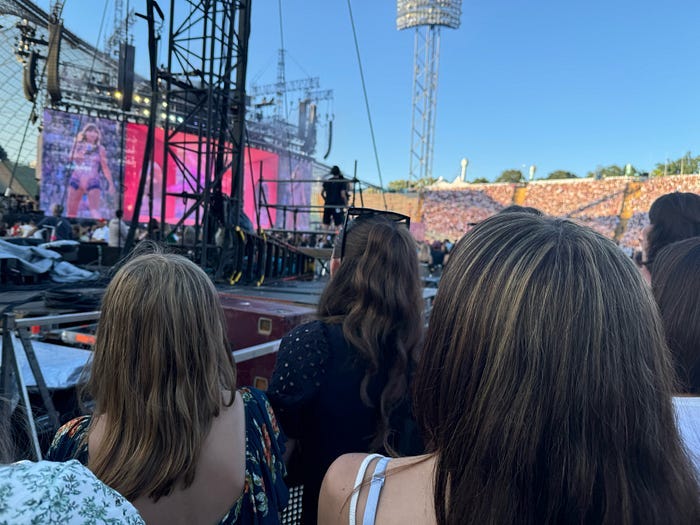
When the two-minute countdown timer for the show started, we had a dead-on view of the stage. My youngest turned to me with a huge smile and said, “Thank you for taking me here. I’m so happy right now.”
What more could my mama heart ask for?
I realized with gratitude how I had the kindness of so many German people to thank for getting us here — and most especially, that mom and her daughter.
What an immense kindness, to make room for us.
I may never find relatives in the old country. I can’t do anything to change the atrocities that happened in Germany to the generations before mine. I will never forget.
But I also have happy memories of my own in this country now, both during my travels in the 90s, and on this wonderful trip with my kids. I hope by traveling there with me, I instilled something in them of what it once meant to be Jewish in Germany.
Traveling with my kids also helped me see beyond the generational trauma that preceded me. Two more generations have passed, and young Germans likely feel no more connected to the Holocaust as perpetrators than my daughters do as victims. We can remember our shared histories while also living in the present without fear.
We can all “stare directly at the sun and also in the mirror,” to be our own Antiheroes.
I can’t feel anything but gratitude and fondness for everyone we met during our Munich stay. People were warm, generous, helpful, and best of all — they helped make our dream of seeing Taylor Swift come true, alongside 124,000 other (mostly German) fans.
Here in Germany, my daughters and I have made some of the best memories of our lives.
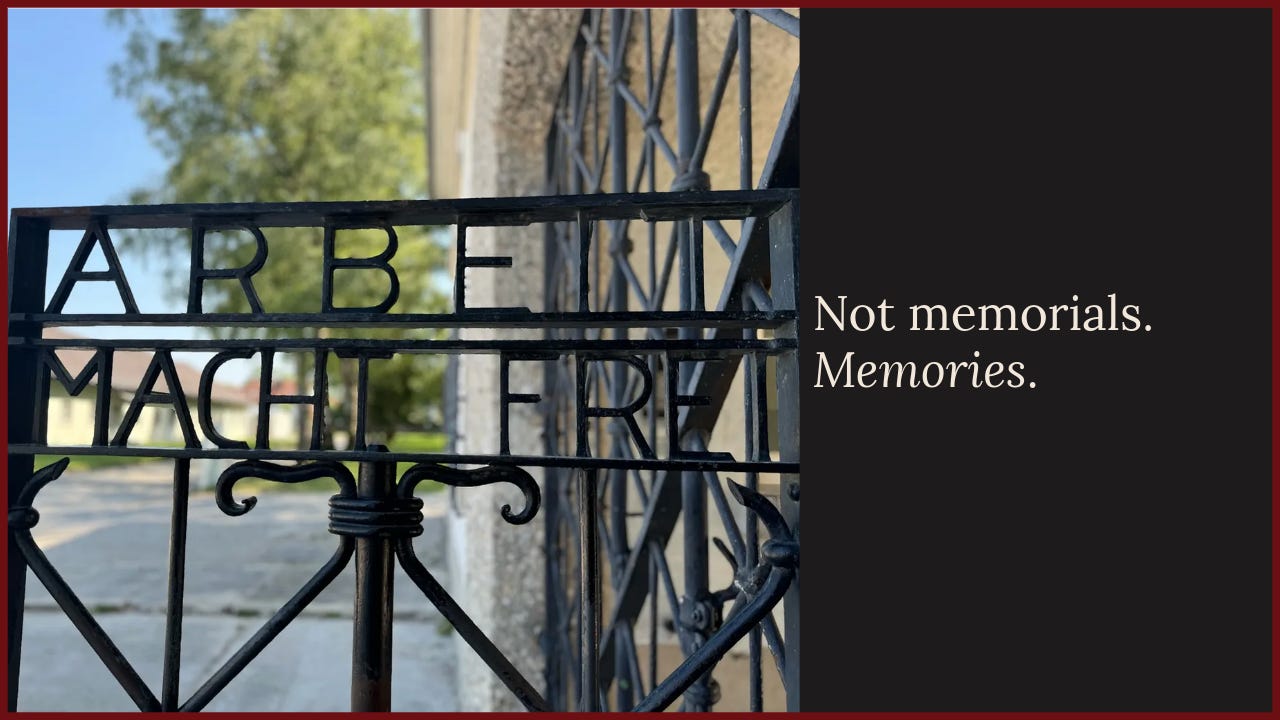
Not just memorials, but memories.
{This story originally appeared in Age of Empathy on Medium on August 4, 2024.}
Thanks for reading.
I’m Dana DuBois, an essayist and GenX word nerd living in the Pacific Northwest—and founder of I Write Out Loud and co-host of The Daily Whatever Show. Through memoir writing, I explore the larger cultural forces shaping relationships, feminism, parenting, media, modern dating, and life in mid-flight. Em-dashes, Oxford commas, and well-placed semi-colons make my heart happy.
If this story resonated with you, please consider supporting my work with a paid subscription.
